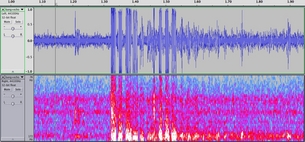
The hydrophone node at the Seattle Aquarium is located beneath the pier at a depth of about 10 meters. It was deployed on January 11, 2007, and utilizes a LabCore System 40 hydrophone fabricated by Lon Brockelhurst. The initial deployment accidently placed the hydrophone on the seafloor, though it sounded fine. The hydrophone was moved to a better location (closer to the end of the pier) on September 3, 2008. Andy Sim sent a diver down in November, 2008, and learned that the hydrophone is in at a depth of ~10m about 3m above the bottom. Custom software written in Visual Basic by Val Veirs (Windows XP) assesses average underwater sound levels and automatically detects "unusual" sounds. The stream is distributed by spacialnet.com
Photos: Seattle Aquarium Flickr set (with captions!)
Each sound file (.mp3 format) is named with year, month, day, start time, end-time, and duration encoded in the file name. The date format is YYMMDD, start/end times are 24-hr format (PDT time zone), and the duration format is HHMMSS. These sounds are presented using a Flash-based player called Wimpy...
Other links:
|
The real-time streams and the Salish Sea hydrophone network are brought to you by our project partners at each node and the administrative team: Beam Reach Marine Science and Sustainability School Colorado College Physics and Environmental Science Departments The Whale Museum of Friday Harbor With generous support from the National Ocean and Atmospheric Administration (NOAA) and the Washington State Department of Fish and Wildlife (WDFW). If you would like to contribute financially, please consider making a donation:
|
![]()
|
Listening guidance
To listen to these links, you must be able to receive ShoutCast streams. iTunes
will do the job (on Mac or Windows computers) for free, though you may need to copy the link and paste it in
"Open Audio Stream" under the "Advanced" menu. Another Windows solution is the free
player from Winamp.
You can also try to record the streams when you hear something that interests you. We recommend Stream Ripper (free, open source, all platforms). If you'd like to explore underwater listening even further (including sound analysis and contributions to citizen science projects), then consider taking on a Beam Reach externship in bioacoustics.
Don't hesitate to contact us if you'd like to make your recording available to the listening community by having us publish it on this web site. In any case, please abide by the Creative Commons license
| Contact: Val Veirs | Contact: Scott Veirs |
Check Statistics | Administer Streams
